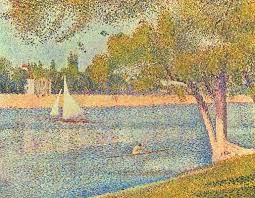
Artist Georges Seurat was the developer of a very scientific way of painting known as pointillism. He used tiny dots of pure colour, side by side to build form in his paintings. These tiny dots of paint, when side by side, give the viewer’s eye a chance to blend the colour optically, rather than having the colours readily blended on the canvas. This was also known as divisionism.
Journal Writing: “Sometimes the smallest things take up the most space in your heart.” – Winnie the Pooh
What do you think this quote means?
What message is the speaker trying to send?
How do you think this quote might apply to your own life?
Numeracy: Math Board Games (decimals, fractions, multiplication, addition/subtraction)
Literacy: Paragraph Colouring
We explored the different components that make up a paragraph: topic sentence, star ideas, details, and concluding sentence.
Learning objective: identifying the components of a paragraph and understanding how they work together.
Example paragraph: Sharks may be scary to many people, but they play a very important role in the world’s oceans. One reason we need sharks is that they keep food webs in balance. Since sharks are the top predators in the ocean food chain, without them, the whole ecosystem would become unbalanced. Another reason is that sharks keep their groups of prey healthy.Sharks often eat fish which are sick or weak and this helps prevent diseases from spreading. It also allows the stronger fish to breed and to transfer their stronger traits to their offspring. The last reason is that sharks help the ocean ecosystem by keeping seagrass beds and other plants healthy.Sharks may scare other animals away from ocean plants, which prevents the plants from being destroyed. For example, sea turtles in Hawaii like to eat sea grass. Tiger sharks like to eat sea turtles. When tiger sharks travel to areas with sea grass, it prevents sea turtles from overgrazing there. The sea turtles will then look for other plants to eat. In conclusion, we need sharks because they are a vital part of the ocean ecosystem.
Science/ADST: Newton’s Cradle
Students applied their understanding of Newton’s Laws of Motion, especially the third law of motion (where every action has an equal and opposite reaction) as they engaged in the ADST process (defining, ideating, prototyping, testing, making, and sharing) to make their very own Newton’s Cradle.
After analyzing what a Newton’s Cradle is and how it is structured, they began planning what their handmade Newton’s cradle would look like (while considering all of the necessary factors such as the marbles hanging at the same level and touching the marble next to it at rest). They were given a variety of materials to work with, and were asked to identify what they needed. Once their plan got approved, they begin to build, make changes, and reflect along the way!